

Evolution of Data Science Interview
Explore how data scientists are shifting from analysts to strategic decision-makers—and the skills needed to thrive in this new era.


The core change in the data science landscape is the transition from a passive, analytical role to an active, decision-making one. In the past, a data scientist might have been seen as the “scorekeeper” for the business, providing reports on metrics like website traffic, user churn, or sales figures. While this information was valuable, the ultimate responsibility for acting on it fell to others, such as product managers or marketing teams.
👋 Hey! This is Manisha Arora from PrepVector. Welcome to the Tech Growth Series, a newsletter that aims to bridge the gap between academic knowledge and practical aspects of data science. My goal is to simplify complicated data concepts, share my perspectives on the latest trends, and share my learnings from building and leading data teams.
Today, the modern data scientist is an integral part of the decision-making process. They don’t just report that a metric has changed; they provide the “why” and recommend the “what’s next.”
For example, instead of just reporting that user engagement dropped by 5%, a modern data scientist would investigate the root cause, perhaps identifying that a new feature update led to confusion for a specific user segment. They would then propose a clear path forward, such as a targeted A/B test to validate a new design or a rollback of the feature for that segment. This strategic influence elevates the role from a mere support function to a central driver of business growth and innovation.
In this newsletter, we break down the key takeaways from a recent webinar with industry experts Siddarth Ranganathan, Director of DS at Microsoft, and Banani Mohapatra, Senior Manager of DS at Walmart. They discussed the significant shifts in the data science landscape and how professionals can adapt to stay ahead.
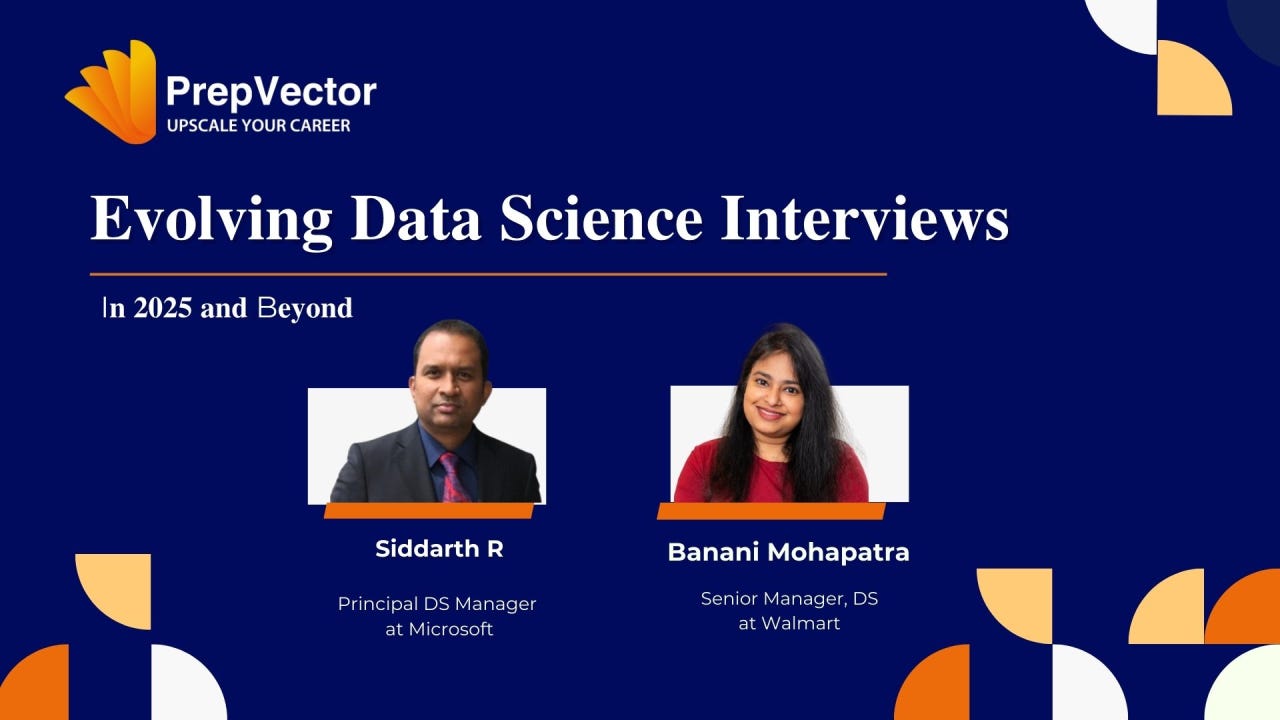
About the Hosts:
Banani is a seasoned data science product leader with over 12 years of experience across e-commerce, payments, and real estate domains. She currently leads a data science team for Walmart’s subscription product, driving growth while supporting fraud prevention and payment optimization. She is known for translating complex data into strategic solutions that accelerate business outcomes.
Siddarth has 20+ years experience across Tech, Healthcare, and eCommerce. He is currently leading a team of 25+ including Data Scientists and Product Managers to deliver high impact initiatives for Azure.
The Evolution of Roles & Interviews
The shift in focus has led to a major restructuring of data science roles.
Gone are the days of the generalist “data scientist” who was expected to do a bit of everything, from building data pipelines to creating machine learning models and delivering business insights. The field has become highly specialized, leading to titles that more accurately reflect the work being done.
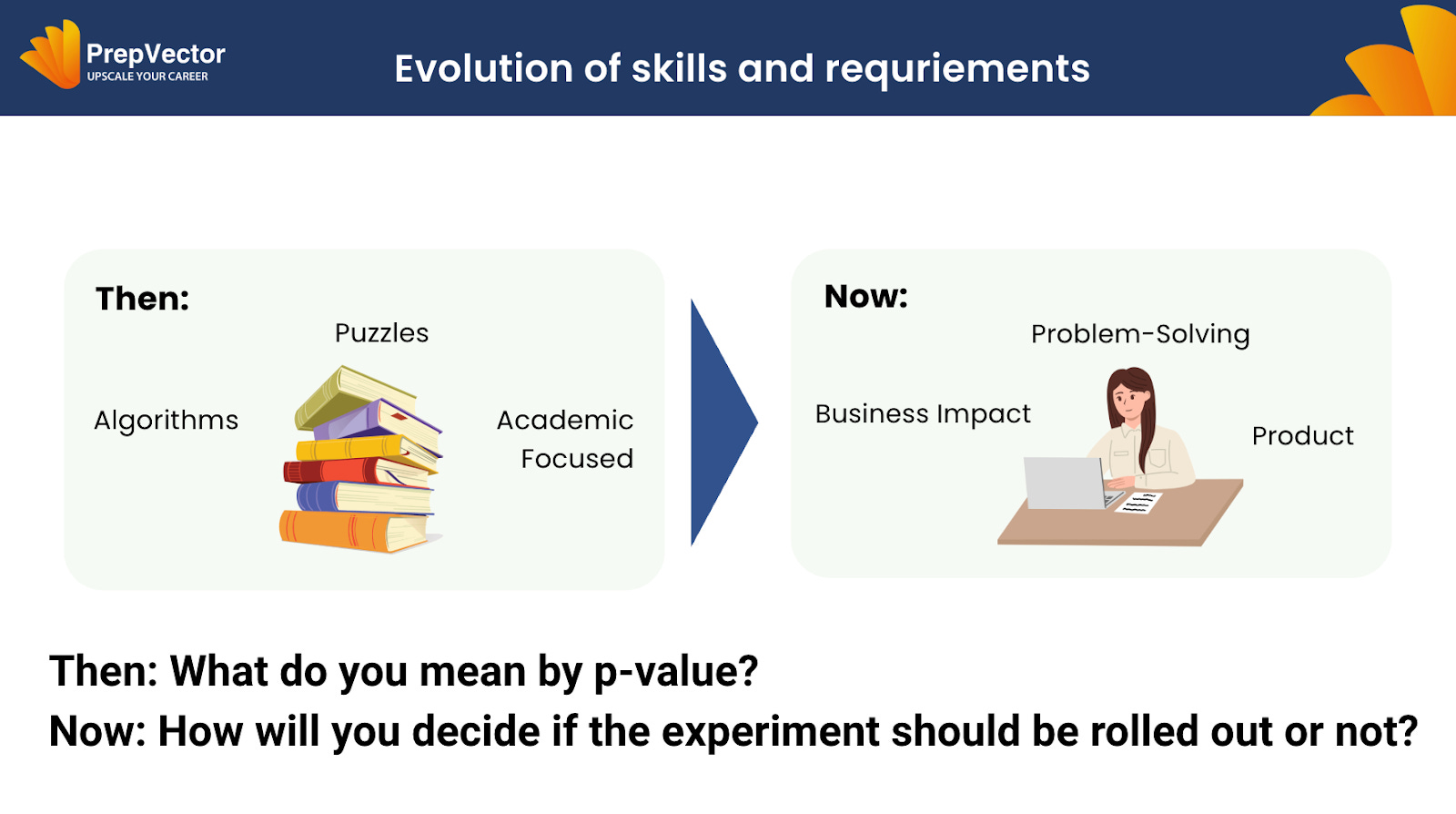
Then: Interview questions were often academic and theoretical. A candidate might be asked to explain what a p-value is or define different types of statistical distributions. The goal was to test their foundational knowledge.
Now: Interviews are far more practical and case-based, mirroring the real-world problems a data scientist solves daily. Questions are designed to assess a candidate’s ability to apply their knowledge to complex business scenarios. For example, an interviewer might present a scenario like, “Our new subscription product is seeing high churn in the first 30 days. How would you investigate this and what would you recommend?” This type of question evaluates a candidate’s product thinking and their ability to design a comprehensive solution, not just recall a definition.
Specialized roles, such as Product Data Scientist, Applied Machine Learning Engineer, or Causal Inference Specialist, are becoming the norm. This specialization allows professionals to become true experts in a specific area, whether it’s understanding user behavior, building production-ready AI systems, or designing complex experiments.
Shameless Plugs:
Master Product Sense and AB Testing, and learn to use statistical methods to drive product growth. I focus on inculcating a problem-solving mindset, and application of data-driven strategies, including A/B Testing, ML, and Causal Inference, to drive product growth.
A/B Testing Course for Data Scientists and Product Managers
Learn how top product data scientists frame hypotheses, pick the right metrics, and turn A/B test results into product decisions. This course combines product thinking, experimentation design, and storytelling—skills that set apart analysts who influence roadmaps.
Essential Skills for the Modern Data Scientist
Modern data science requires a blend of technical prowess and business acumen. Companies now look for a combination of skills that go far beyond just a strong grasp of Python or SQL.
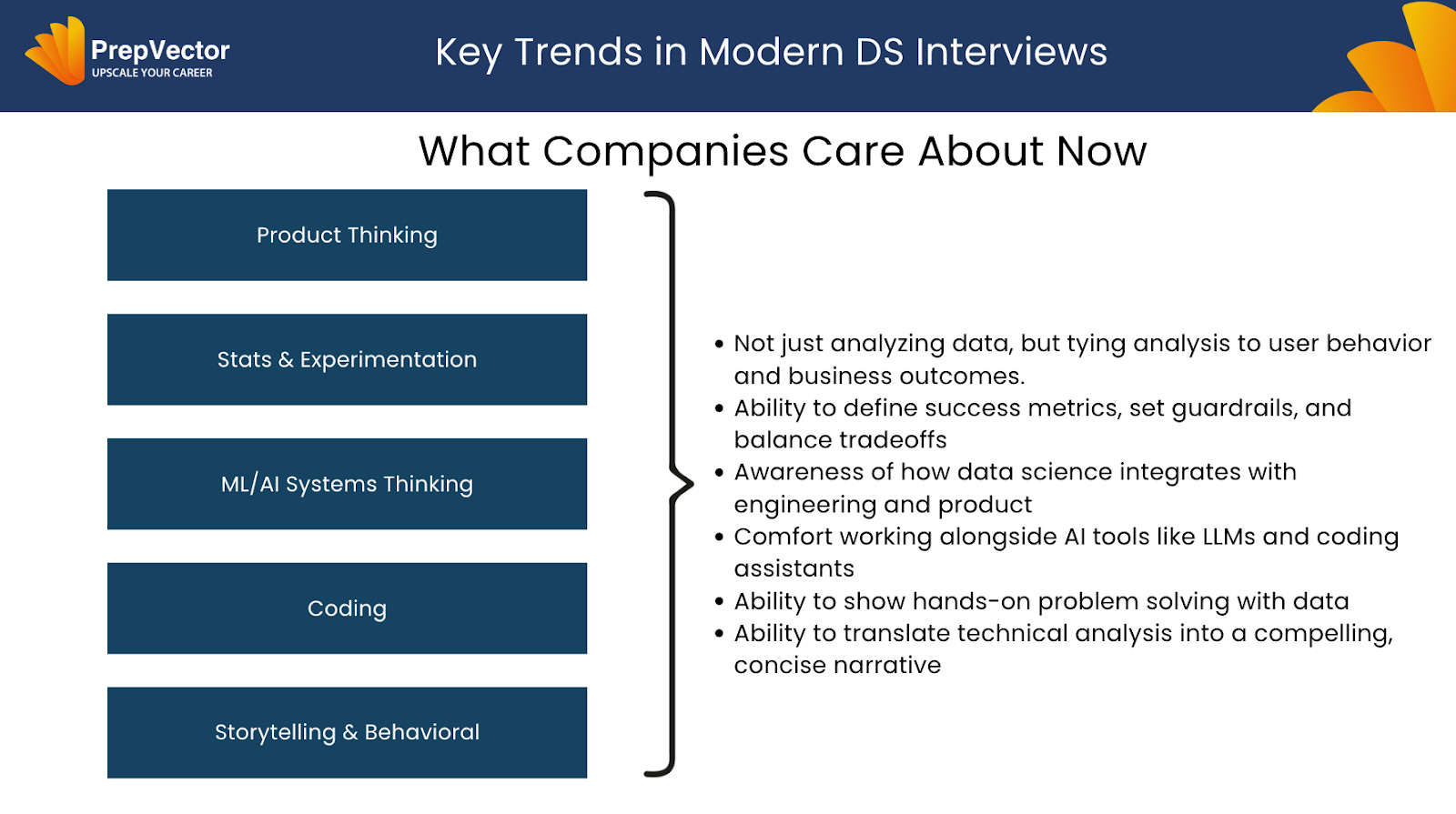
Product Thinking: This is the most crucial skill for a modern data scientist. It involves understanding the business context and connecting your work directly to product strategy and business outcomes. Instead of just analyzing a dataset, you need to ask questions like: “What user problem are we trying to solve?” and “How does this metric relate to our company’s mission?”
Stats & Experimentation: While A/B testing has been a staple, the use cases have become more complex. Modern data scientists need to design and analyze sophisticated experiments, accounting for network effects, novelty effects, and long-term impacts. For senior roles, a deep understanding of causal inference is essential to truly understand cause-and-effect relationships and move beyond simple correlations.
ML/AI Systems Thinking: It’s no longer enough to just build a model in a Jupyter notebook. Today’s data scientists are expected to understand the full model lifecycle, from data collection and feature engineering to deployment, monitoring, and maintenance in a production environment. This includes understanding the potential for bias, managing model drift, and ensuring the system is scalable.
Coding: SQL and Python remain foundational skills. SQL is paramount for roles focused on product analytics and business intelligence, as it’s the language for querying and manipulating data. Python is critical for building models, performing statistical analysis, and creating scalable solutions. Proficiency in both is non-negotiable.
Storytelling & Behavioral Skills: You could have the most profound insight in the world, but if you can’t communicate it effectively, it’s useless. The ability to translate complex statistical findings into a compelling and clear narrative for a non-technical audience is vital. This skill, often evaluated through behavioral and case study questions, involves working with cross-functional teams and influencing decisions based on your data-driven recommendations.
The Impact of AI: A Partner, Not a Replacement
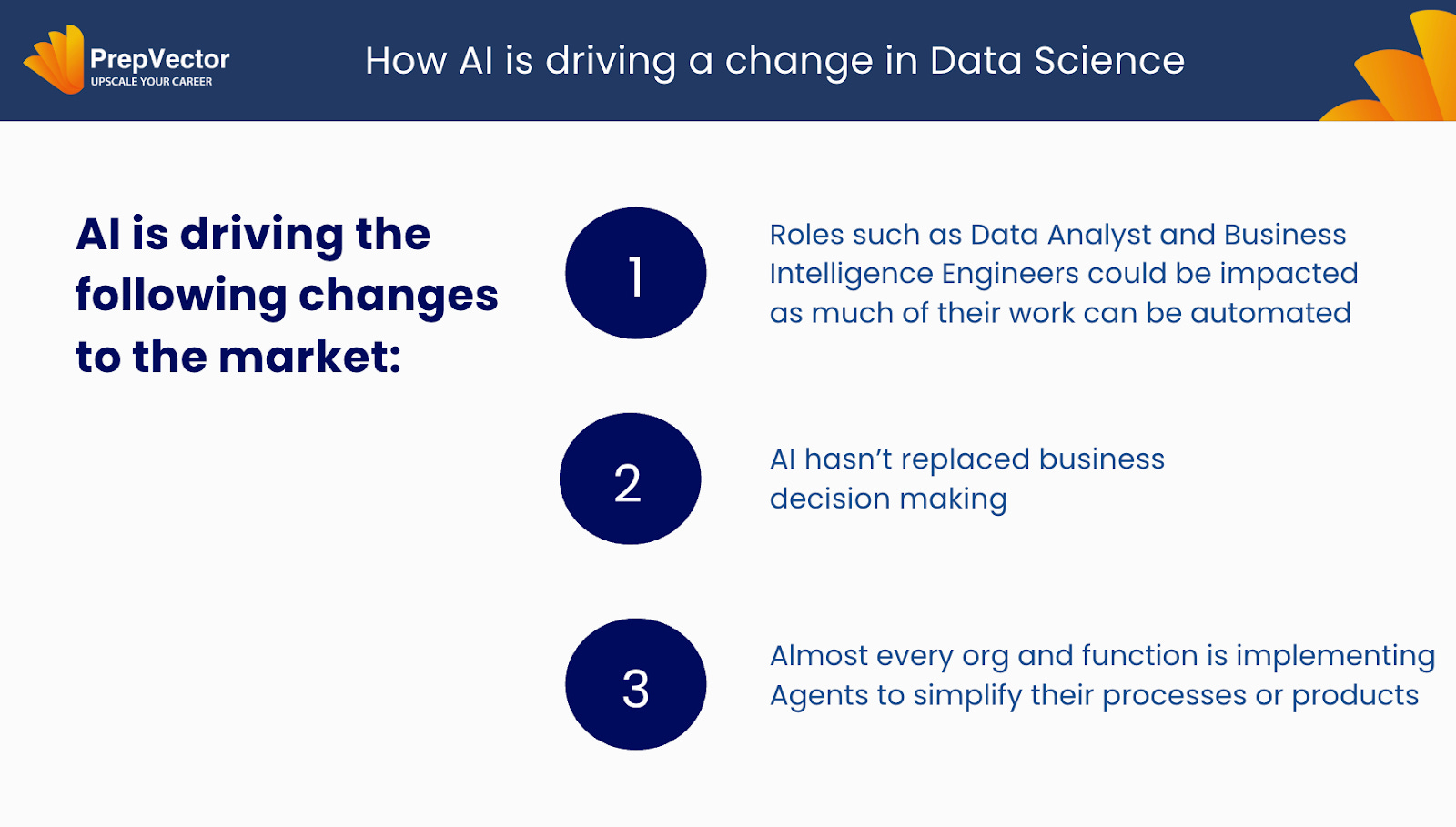
The rise of generative AI has led to speculation about its impact on data science jobs. While AI tools can automate routine tasks, such as generating SQL queries or writing basic code, they are not a replacement for human judgment and strategic thinking. AI is a powerful tool that can handle the low-level, repetitive tasks that once consumed a data scientist’s time, freeing them up to focus on higher-level, strategic work.
The key is to view AI as another feature in your toolkit. Rather than fearing replacement, data scientists should focus on building on their core domain skills, which are impossible for a machine to replicate. This includes understanding business strategy, navigating complex social dynamics, and applying human creativity to solve novel problems. The most successful data scientists will be those who can leverage AI to accelerate their work, focusing their unique human skills on the critical tasks of problem framing, strategic decision-making, and impactful communication.
Ready to Master Modern Data Science?
The evolving landscape of data science demands more than just technical skills; it requires strategic thinking and a deep understanding of business impact. If you’re serious about taking your career to the next level and mastering the skills discussed in this newsletter, our Product Data Science Course is the perfect solution.
Designed to help you navigate this new era of specialized roles, our in-depth curriculum is taught by industry experts. You’ll learn to apply your knowledge through case-style interviews, develop your product thinking, and perfect your storytelling skills.
Ready to upscale your career?
Book a Free Consultation today!
Upcoming Courses:
Master Product Sense and AB Testing, and learn to use statistical methods to drive product growth. I focus on inculcating a problem-solving mindset, and application of data-driven strategies, including A/B Testing, ML, and Causal Inference, to drive product growth.
A/B Testing Course for Data Scientists and Product Managers
Learn how top product data scientists frame hypotheses, pick the right metrics, and turn A/B test results into product decisions. This course combines product thinking, experimentation design, and storytelling—skills that set apart analysts who influence roadmaps.
Not sure which course aligns with your goals? Send me a message on LinkedIn with your background and aspirations, and I’ll help you find the best fit for your journey.
 | A guest post by
|
 | A guest post by
|