

Explain Like I am 5 | Day 06: Understanding P-Values
Explain Like I’m Five Series | Lesson 06 - Understanding P-value. One core experimentation concept, explained with clarity and practical intuition.

P-value is one of the most important ideas in statistics and A/B testing. When you understand it deeply and connect it to your actual problem, it helps you know whether your experiment really worked or if you just got lucky. But here’s the thing p-value is confusing when you read its official definition. So today, let’s explain it the way you’d explain it to a five-year-old.
The Toy Car Race
Imagine you and your sibling Sam each have a toy car. You’re absolutely sure yours is faster, but Sam disagrees and says you’re wrong, the cars are equally fast. So you decide to settle this by racing 10 times. Whoever wins more races has the faster car.
Result: You win 8 times.Sam wins twice.
You start teasing and celebrating. But Sam gets annoyed and says, “That’s just luck! My car is just as fast as yours. You just happened to win four times. That doesn’t mean anything!”
Now you’re stuck. Is Sam right? Did you just get lucky? Or does your car really move faster?
P-value will help you conclude
Imagine you race with Sam 10 times, then you both reset and race 10 more times. Then you do this whole thing again and again a hundred times total.
If your cars were actually identical, what would happen?
Many times you’d tie at 5-5
Sometimes you’d win 6-4.
Occasionally you’d win 7-3.
Rarely you’d win 8-2 or 9-1 or 10-0.
The important question is: “In our hundred race sets, if both cars were truly identical, how many times would you see a result as good as your actual result winning 8 or more times?” This is what p-value answers.
P-value is a probability between 0 and 1, representing how surprising your data is if the assumption of "no difference" is true.
When P-Value Is Small (say 0.03)
If both cars were identical, getting this result (winning by 8-2) would happen only 3 out of 100 times by chance.
Since this outcome is rare, your current win is probably not just by chance.So, your car is likely faster.
Small p-value means your result is surprising if nothing special was happening. So something special is probably happening.
When P-Value Is Large (say 0.30)
If both cars were identical, getting this result (winning by 8-2) would happen only 30 out of 100 times by chance.
Since it happens quite often, the current result of 8-2 could easily be by chance. So, we cannot say your car is faster.
Large p-value means: your result isn’t surprising at all. It could easily have happened by chance.
So, the winner is?
In your case, the p-value came out to 0.03. That’s small enough to prove your car really is faster. You won the argument. Your car was genuinely faster than your Sam’s car, and it wasn’t just luck.
In Data Science Terms
When scientists and statisticians talk about p-value, here’s what they mean: P-value measures how surprising your results would be if there was actually no difference at all.
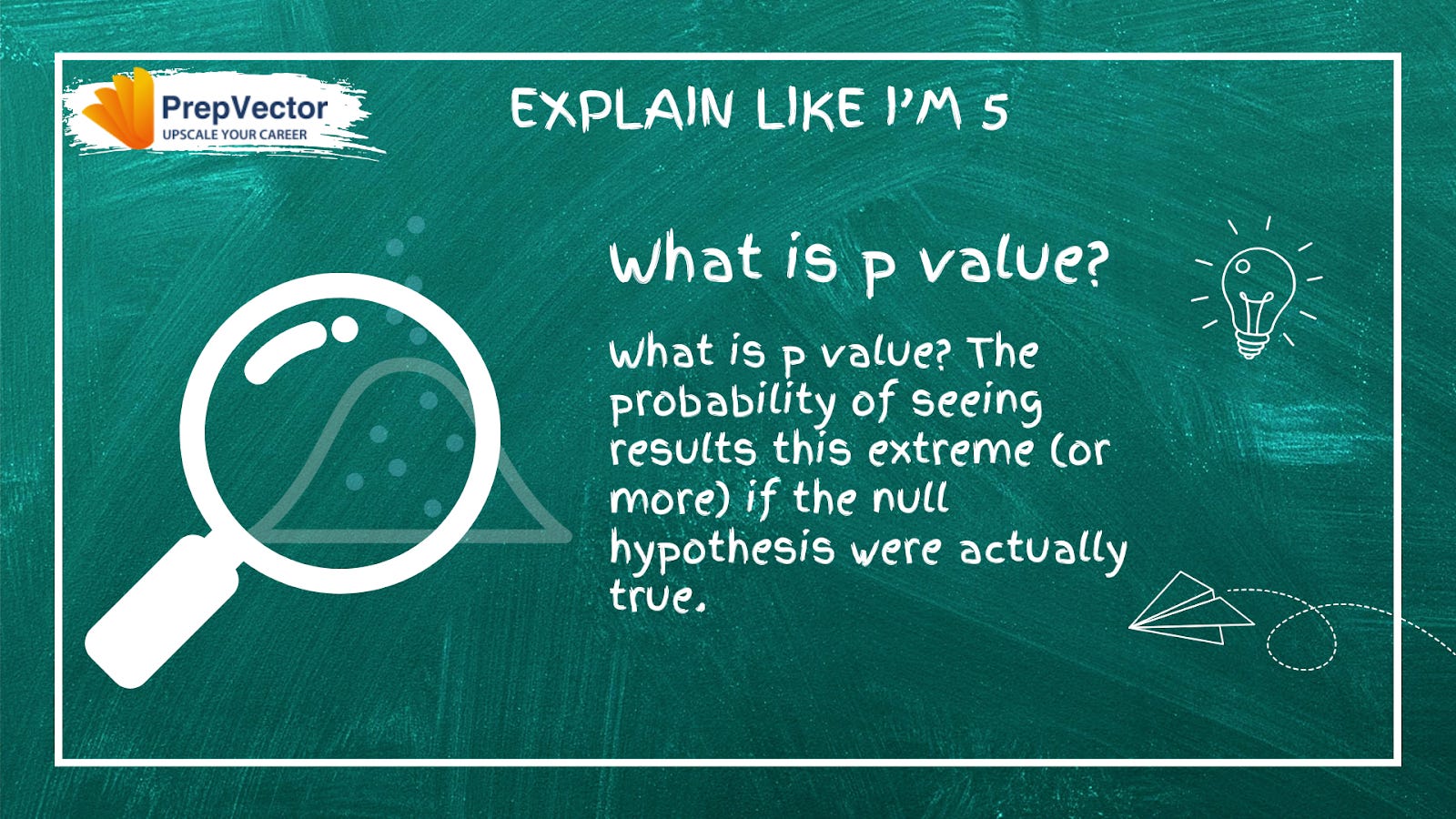
A small p-value (like 0.03) means your results are very surprising if nothing special is happening. That’s strong evidence that something really is different.
A large p-value (like 0.30) means your results aren’t surprising at all; they could easily happen by luck. That’s weak evidence that something is actually different. That’s the power of p-value. It helps you know whether your win was real or just a lucky streak.
Small p-value only means statistically detectable, not business meaningful. Example: A +0.2% CTR improvement might have p value of = 0.001 (very significant). But the revenue impact ≈ negligible.
So always check effect size + business impact
But how small is too small for a p value? Stay tuned for next post.
If you’d like to dive deeper into experimentation, here are a few of our learning programs you might enjoy:
A/B Testing Course for Data Scientists and Product Managers
Learn how top product data scientists frame hypotheses, pick the right metrics, and turn A/B test results into product decisions. This course combines product thinking, experimentation design, and storytelling-skills that set apart analysts who influence roadmaps.
Advanced A/B Testing for Data Scientists
Master the experimentation frameworks used by leading tech teams. Learn to design powerful tests, analyze results with statistical rigor, and translate insights into product growth. A hands-on program for data scientists ready to influence strategy through experimentation.
Master Product Sense and AB Testing, and learn to use statistical methods to drive product growth. I focus on inculcating a problem-solving mindset, and application of data-driven strategies, including A/B Testing, ML, and Causal Inference, to drive product growth.
Not sure which course aligns with your goals? Send me a message on LinkedIn with your background and aspirations, and I’ll help you find the best fit for your journey.