
Forward Deployed Engineers: Skills, Career Path, and Why This Role Is Here to Stay
The future of enterprise AI belongs to engineers who can navigate ambiguity, work with customers, and ship solutions that people actually use.

In the first part of this series, we explored why Forward Deployed Engineers (FDEs) have become one of the fastest-growing roles in enterprise AI.
The biggest takeaway was that
“Companies aren’t struggling to find AI models anymore. They’re struggling to make those models useful inside real businesses.”
How is FDE different from AI Engineers?
Many people assume an FDE is simply another name for an AI Engineer. The two roles certainly overlap.
But AI Engineers primarily focus on building reliable, scalable AI capabilities, while Forward Deployed Engineers focus on making those capabilities work inside a customer’s environment.
That means dealing with
Ambiguous requirements
Communicating with both technical and business stakeholders
Understanding existing workflows
Integrating with enterprise systems
Continuously adapting the solution until it delivers measurable business value.
The technology may be similar, but the day-to-day work is shaped by customer problems rather than product features.
👋 Hey! This is Siddarth R from PrepVector. Welcome to the Tech Growth Series, a newsletter that aims to bridge the gap between academic knowledge and practical aspects of data science. My goal is to simplify complicated data concepts, share my perspectives on the latest trends, and share my learnings from building and leading data teams.
A Typical FDE Project
Imagine a large insurance company approaches an AI company with a simple request:
“We want to use AI to process insurance claims faster.”
An AI Engineer might immediately start thinking about document parsing, retrieval pipelines, or prompt engineering.
The first step of FDE is understanding how claims are processed today.
Questions usually include:
Where do claim documents originate?
Which teams review them?
Which decisions require human approval?
What regulations must be followed?
Which systems store customer information?
Where do employees spend the most time?
Often, the original request isn’t the real problem. A customer may believe document summarization is the bottleneck, only to discover employees actually lose the most time searching across disconnected systems or waiting on approvals.
Only after understanding the workflow does technical design begin. The FDE works with customer teams to define what success looks like :
Reducing claim processing time from five days to two.
Helping adjusters review 30% more claims every week.
Lowering manual effort without compromising compliance.
Those business outcomes become the project’s success metrics.
The implementation involves familiar engineering work: integrating APIs, building retrieval pipelines, designing prompts, and deploying to production.
But that’s only part of the job. Once employees start using the system, new demands surface
Users point out missing information.
Legal teams request additional guardrails.
Security teams ask for tighter permissions.
Executives want usage metrics.
The FDE keeps refining the solution alongside customers and product teams, making FDEs one of the strongest feedback loops between customers and product teams.
The skill set is broader than most engineering roles
Because FDEs work across so many different problems, their skill set extends well beyond traditional software engineering.
Technical fundamentals still matter. You’ll work with APIs, cloud platforms, authentication, databases, distributed systems, and production deployments, the same core skills any strong engineer needs.
Modern AI literacy is now table stakes. That means understanding RAG, embeddings, evaluation frameworks, agent workflows, vector databases, and , just as importantly, where models fall short.
But technical skill alone doesn’t make an FDE successful. FDEs spend more time asking questions than writing code. They need to understand why a workflow exists, which business metrics actually matter, where the operational bottlenecks are, and whether AI is even the right answer.
Navigating ambiguity is another core skill. Customers rarely show up with a spec. More often, it’s: “We think AI could help our support team.” Turning that vague objective into a deployable system requires structured thinking and strong communication. .
Communication ties it all together. An FDE might discuss infrastructure with engineers in the morning, walk legal through compliance in the afternoon, and demo a prototype to executives by evening. So communication is equally important.
Different Backgrounds, Same Destination
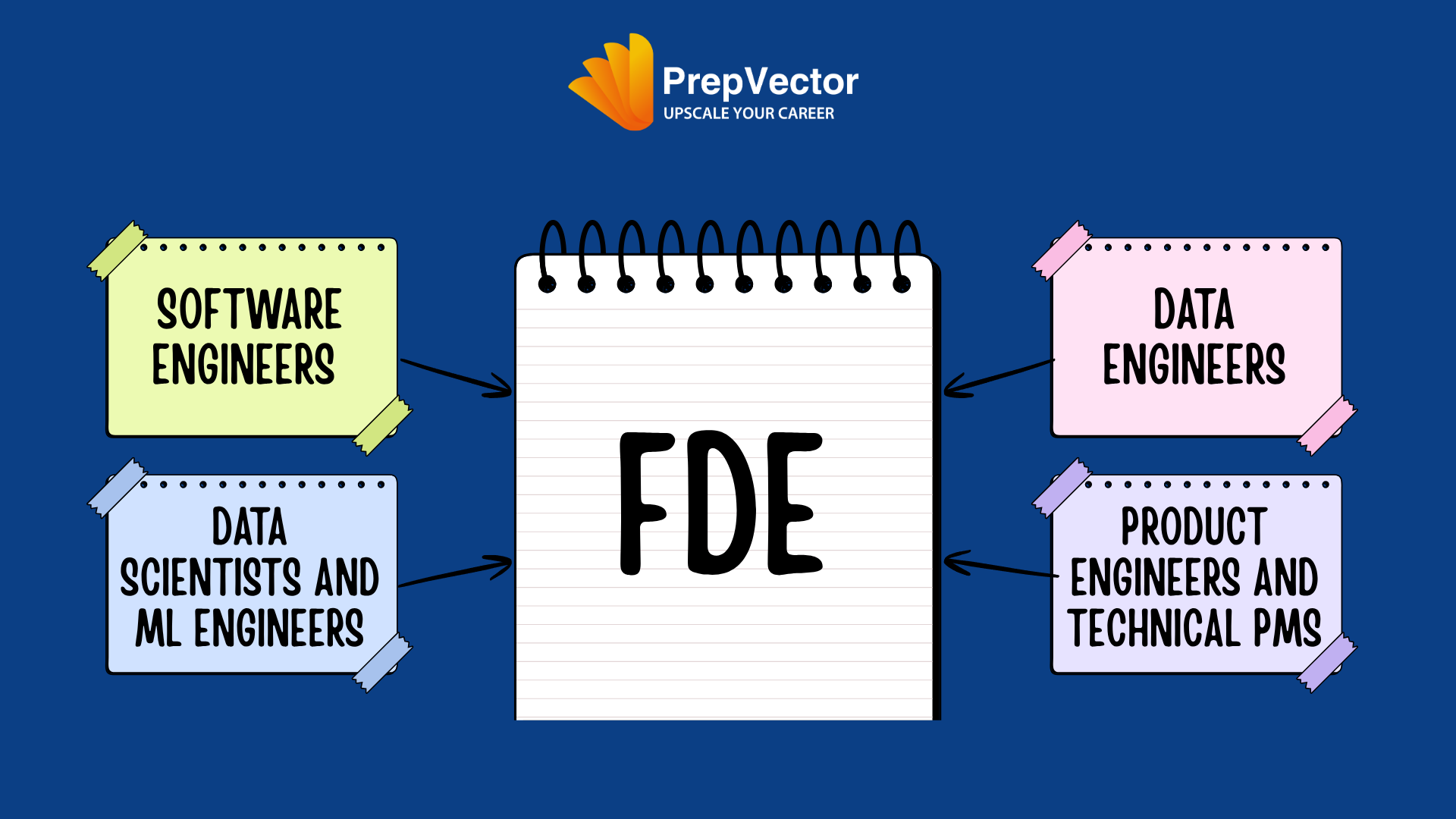
FDE hiring has grown fast partly because there’s no single path into the role.
Software Engineers already have strong foundations in backend systems, architecture, and production deployments. The biggest adjustment is learning to let customer priorities and guide technical decisions.
Data Scientists and ML Engineers: In enterprise AI, much of the value comes from evaluation, experimentation, retrieval, and integrating existing models into business workflows. Their experience with experimentation and metrics becomes a major advantage.
Data Engineers already understand pipelines, databases, permissions, and data quality—the foundations every production AI system depends on. The next step is learning how those systems become customer-facing AI applications.
Product Engineers and Technical PMs transition well because they naturally ask, “What problem are we solving?” before deciding what to build. That mindset helps avoid technically impressive solutions that customers never adopt.
The ecosystem opportunity and its trade-offs
“Forward Deployed Engineers don’t just help customers adopt AI. They also help AI companies build better products.”
Another interesting trend is how AI companies are expanding beyond models.
Organizations deploying AI also need retrieval, evaluation, monitoring, security, governance, orchestration, identity management, and deployment capabilities. AI companies are increasingly offering these as integrated platforms and products which can act as a big boost in their revenue model.
Forward Deployed Engineers play a critical role in helping customers adopt these ecosystems while providing valuable feedback that shapes future products for AI companies
However, there is a trade-off.
The deeper an organization builds around one AI platform, the harder it becomes to switch later. Replacing a foundation model is often manageable, but replacing the surrounding evaluation pipelines, security integrations, workflows, monitoring tools, and developer infrastructure is considerably more difficult.
Cloud computing followed a similar path, and enterprise AI appears to be moving in the same direction.
Looking ahead
Whether the title “Forward Deployed Engineer” remains popular is difficult to predict. But the underlying need is unlikely to disappear.
As AI models become increasingly capable and accessible, competitive advantage shifts toward workflow design, proprietary data, governance, security, evaluation, and user adoption. That is exactly where FDEs create value.
This doesn’t mean every engineer should become one. Many will continue to specialize in infrastructure, distributed systems, machine learning research, or platform engineering.
But for engineers who enjoy solving ambiguous problems, working directly with customers, influencing product direction, and seeing measurable business impact, Forward Deployed Engineering offers a unique career path.
As AI continues moving from research labs into every industry, the ability to connect technology with real business outcomes may become one of the most valuable engineering skills of the next decade.
In the next part of this series, we’ll focus on how Data Scientists can transition to FDE roles.
Stay tuned!
If you’d like to dive deeper into experimentation, here are a few of our learning programs you might enjoy:
Causal Inference Weekend Course
Learn how leading data scientists move beyond correlation and use causal reasoning to drive better business and product decisions. This course covers the full causal toolkit from Difference-in-Differences and Regression Discontinuity to Propensity Score Matching, Instrumental Variables, and Double Machine Learning so you can produce analyses that are credible, defensible, and decision-ready.
Master Product Sense and AB Testing and learn to use statistical methods to drive product growth. I focus on inculcating a problem-solving mindset, and application of data-driven strategies, including A/B Testing, ML, and Causal Inference, to drive product growth.
Not sure which course aligns with your goals? Send me a message on LinkedIn with your background and aspirations, and I’ll help you find the best fit for your journey.