
How to Decode Data Science Roles: Webinar Recap
The Data Science role spectrum, what has changed in 2026, and where you actually fit.

Let’s be honest for a second.
If you’ve been applying to every Data Scientist role you come across, tweaking your resume endlessly, and still not getting the right interviews, the problem probably might not be your skills.
It can be targeting.
Last week, Siddarth Ranganathan, Director of Data Science at Microsoft with 20+ years across Tech, Healthcare, and eCommerce hosted a live session with us. And within the first ten minutes, he said something that made a lot of heads nod:
“Data Scientist is not a single job. It spans vastly different skill sets and misaligned positioning leads to mismatched interviews and rejections.”
👋 Hey! This is Siddarth R from PrepVector. Welcome to the Tech Growth Series, a newsletter that aims to bridge the gap between academic knowledge and practical aspects of data science. My goal is to simplify complicated data concepts, share my perspectives on the latest trends, and share my learnings from building and leading data teams.
You’re Not Applying to One Role. You’re Applying to Five.
Here’s what most job seekers miss. “Data Scientist” on a job posting can mean completely different things depending on the company. Siddarth broke it down into a spectrum that finally makes sense of the chaos:
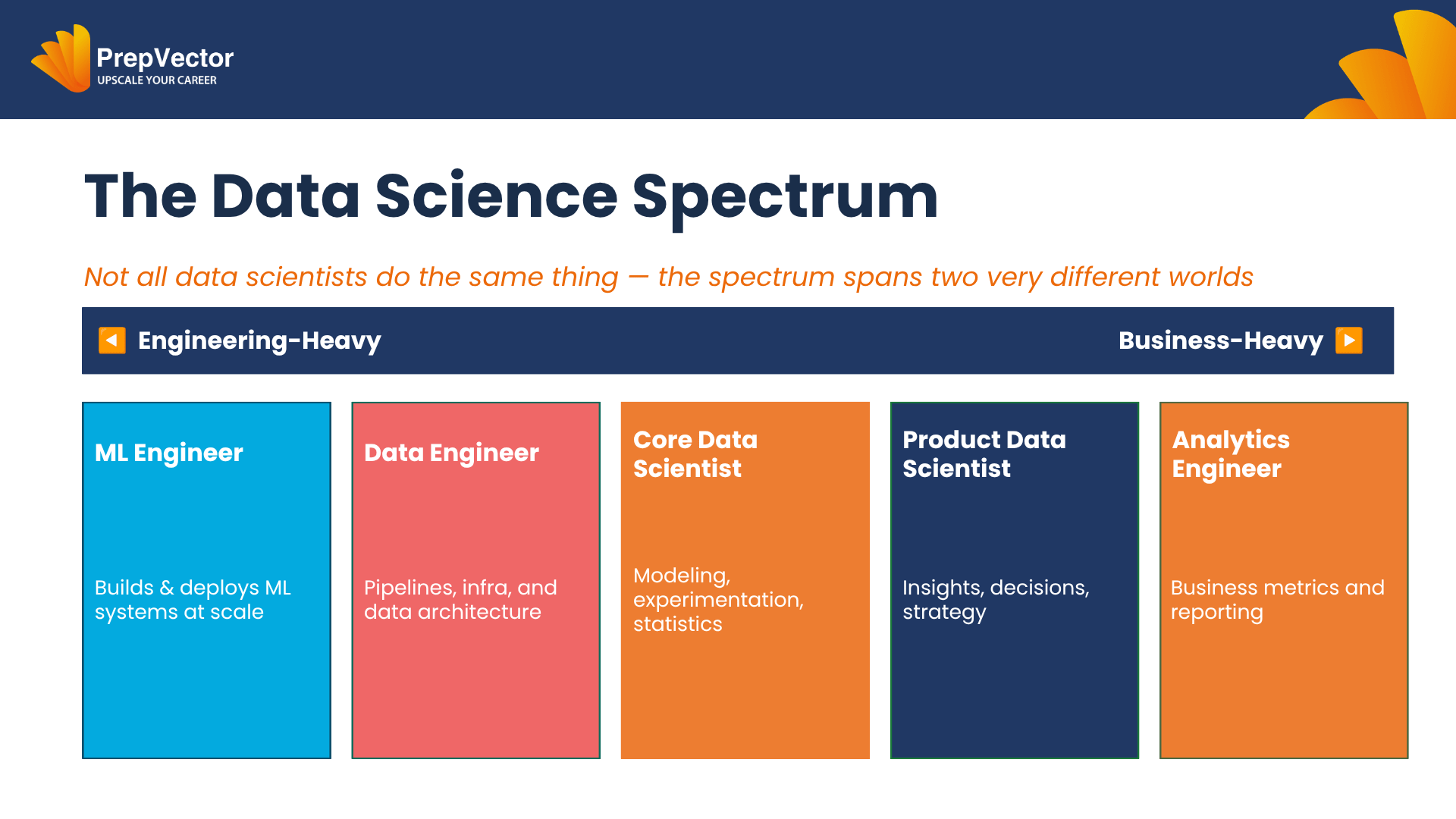
On the left: ML Engineers and Data Engineers. Think Kubernetes, Spark, PyTorch. You’re building the systems. The code is the product.
On the right: Product Data Scientists and Analytics Engineers. You’re informing decisions, running experiments, translating data into strategies that move the business.
In the middle: Core Data Scientists. Statistics-heavy, modeling-focused, bridging both worlds.
The question you need to ask yourself honestly: where on this spectrum do you actually belong?
What’s Changed and Why It Matters to You Right Now
The Data Science job market is restructuring. Here’s what you need to know:
Generalist DS roles are quietly fading. Companies are now building specialist teams. The “does-everything unicorn data scientist” is becoming rare. If you’re positioning yourself as a generalist, you’re swimming against the current.
AI fluency is no longer your edge, it’s your entry ticket. Siddarth pulled up a real Meta job description live, and the LLM and GenAI requirements on it simply didn’t exist two years ago. If you can’t speak to AI workflows, prompt evaluation, or responsible AI principles in your next interview, you’re already a step behind.
The opportunity, though, is massive.
“The Bureau of Labor Statistics projects 34% growth in DS jobs from 2024–2034 the 4th fastest-growing occupation in the entire US economy.”
The jobs are there. But they’re going to candidates who are specific, not those who are broad.
Future of Product Data Science Roles
Of everything discussed in the session, Siddarth made the strongest case for one path: Product Data Scientist.
Why? Because it’s the hardest to automate. Strategy, stakeholder judgment, communication these are human skills. AutoML is already automating modeling roles. The industry needs data scientists who can build, reason, and influence. These are key traits you learn when you sit closer to the product or business.
Because you sit at the decision table, you influence roadmaps, resource allocation, go-to-market strategy. That kind of visibility accelerates your career in ways that technical-only roles often don’t.
And because AI makes you more powerful, not redundant. Faster analysis means more time for the insights that actually move the needle.
“The ability to frame the RIGHT problem for AI to solve, not just run models, is the new differentiator.”
So Where Do You Fit?
Here’s a quick check. When you see a data problem, what’s your first instinct
Build a better model, or understand the business question behind it?
Do you get more energy from a complex technical challenge or from influencing a strategic decision?
So far, have your go-to tools been PyTorch and Kubernetes, or SQL and Tableau?
Your honest answers will tell you more about your natural fit than any job title ever will.
The only question left is, are you going to keep applying broadly and hoping for the best, or are you going to position yourself with intention?
If you’re leaning toward Product Data Science and want to close the gap fast, PrepVector’s Product Data Science course is built exactly for this moment A/B testing, AI fluency, product metrics, case interviews, and mock sessions with real interviewers who’ve sat on the other side of the table.
Just the skills the 2026 market is actually hiring for.
There’s More Coming. Two More Free Sessions
This was Session 1 of a free 3-part series. Two more are coming up, and honestly, they go even deeper into what actually gets you hired:
Jun 12 — Cracking A/B Testing Interviews: A/B testing shows up in almost every DS interview. This session goes beyond the textbook, how to reason under ambiguity, make tradeoffs explicit, and connect experiments to real business decisions.
Jun 19 — How Big Tech Actually Evaluates DS Candidates: What does the hiring bar at a top tech company actually look like? Product sense, experimentation design, AI fluency. Siddarth breaks down exactly what interviewers are looking for and where most candidates fall short.
Both are free. Both are live with Q&A.
If you’d like to dive deeper into experimentation, here are a few of our learning programs you might enjoy:
Causal Inference Weekend Course
Learn how leading data scientists move beyond correlation and use causal reasoning to drive better business and product decisions. This course covers the full causal toolkit from Difference-in-Differences and Regression Discontinuity to Propensity Score Matching, Instrumental Variables, and Double Machine Learning so you can produce analyses that are credible, defensible, and decision-ready.
Master Product Sense and AB Testing and learn to use statistical methods to drive product growth. I focus on inculcating a problem-solving mindset, and application of data-driven strategies, including A/B Testing, ML, and Causal Inference, to drive product growth.
Not sure which course aligns with your goals? Send me a message on LinkedIn with your background and aspirations, and I’ll help you find the best fit for your journey.