

How to Get Past the Resume Screen & Early Hiring Stages
In this edition of the Hiring Insights Series, we break down how resumes are evaluated, what recruiters look for, and how to make a strong first impression to move forward in the hiring process.

👋 Hey! This is Manisha Arora from PrepVector. Welcome to the Tech Growth Series, a newsletter that aims to bridge the gap between academic knowledge and practical aspects of data science. My goal is to simplify complicated data concepts, share my perspectives on the latest trends, and share my learnings from building and leading data teams.
The Hiring Insights Series is designed to demystify the Data Science hiring process, providing a behind-the-scenes look at how recruiters and hiring managers evaluate candidates at every stage. From resume screening to technical interviews and final offer decisions, we’ll break down what actually happens after you apply—and how you can optimize your approach to land more offers.
In the last edition of the hiring series, I shared insights on the real-world hiring funnel data from my conversations with two spoke hiring managers:
👤 Banani Mohapatra, Senior DS Manager at Walmart
👤 Siddarth R, Director of DS at Microsoft
They shared insights on how hiring decisions are made, why strong candidates still get rejected, and what separates the top 1% from the rest. Some of the key takeaways:
📌 Hiring is extremely selective → Banani’s team reviewed 230+ applications for one DS role, but only 7% reached the hiring manager and <1% received an offer.
📌 Siddarth’s team had an even lower selection rate → Out of 500+ applications, only 1 final hire was made, highlighting how tough it is to stand out.
This edition will break down:
✅ How resume screening works and why most applications are rejected
✅ What recruiters are looking for in the first call
✅ What hiring managers assess in the initial screening interview
Let’s dive in.
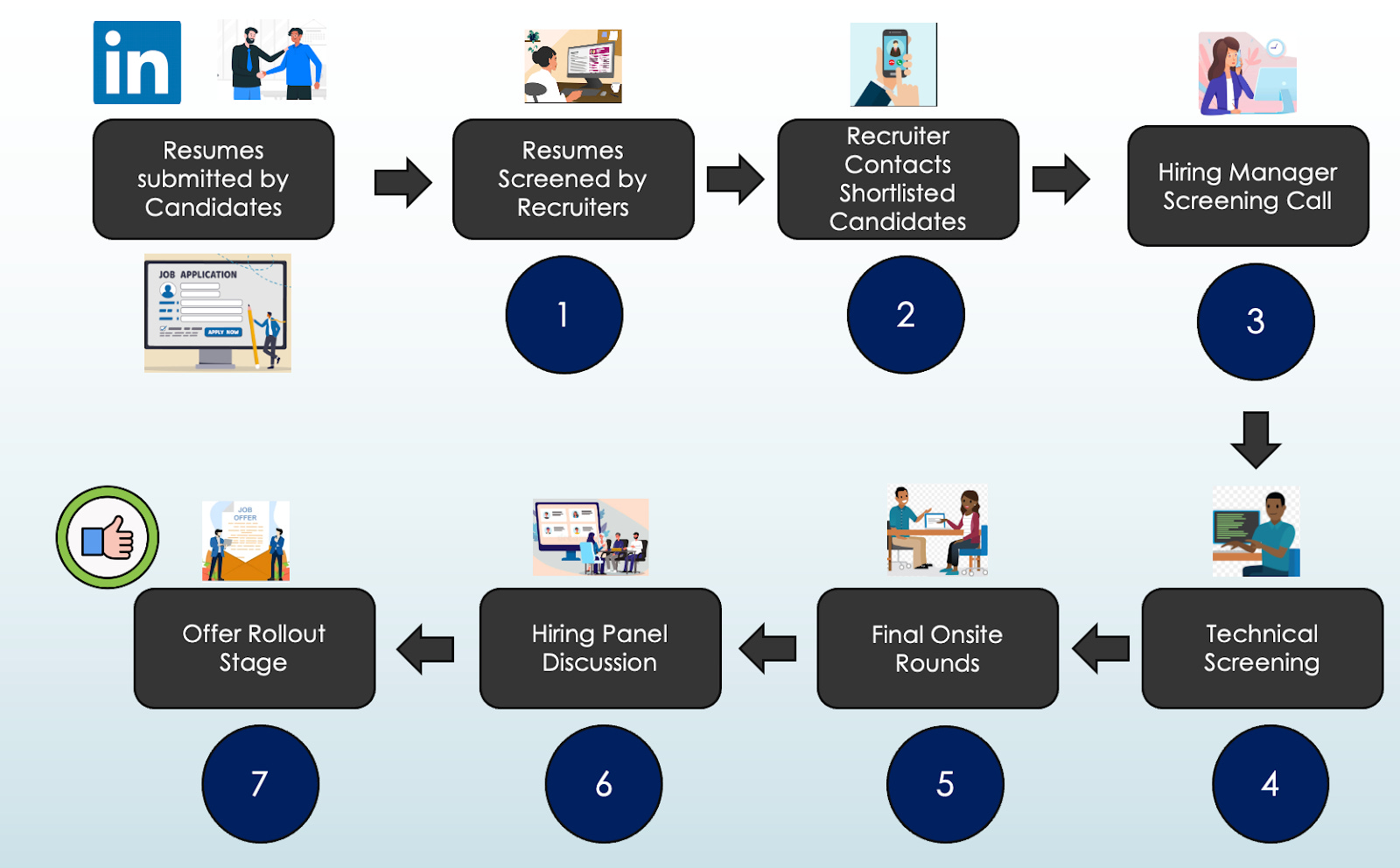
Step 1: Resume Screening - The First Gatekeeper
At larger companies, recruiters are typically the first line of defense when it comes to reviewing resumes. Their goal? Quickly filter out candidates who don’t meet the basic qualifications for the role. Given the volume of resumes they process, they need to assess whether you are a potential fit in just a few seconds.
Here’s what they’re scanning for:
✅ Years of Experience: Does your experience align with what the job description asks for in terms of years of experience?
✅ Technical Skills: Are you proficient in the skills listed in the JD—SQL, Python, machine learning, and business acumen?
✅ Industry Expertise: While it’s not always a dealbreaker, certain roles may prefer candidates with domain expertise—for instance, e-commerce or fintech.
✅ Resume Clarity & Structure: A well-organized resume will naturally attract more attention.
Some companies might require domain specific experience. For example - a DS role at a three-sided marketplace (say, Doordash) might prefer experience with similar B2C products or in similar growth teams. But mostly this is a preference and shouldn’t be a blocker for you to apply for the role.
💡 Pro Tip:
Make sure your resume mirrors the keywords in the job description. This helps optimize your resume for ATS systems and ensures that your profile catches the recruiter’s attention.
Shameless plugs:
Master Product Sense and AB Testing, and learn to use statistical methods to drive product growth. I focus on inculcating a problem-solving mindset, and application of data-driven strategies, including A/B Testing, ML, and Causal Inference, to drive product growth.
AI/ML Projects for Data Professionals
Gain hands-on experience and build a portfolio of industry AI/ML projects. Scope ML Projects, get stakeholder buy-in, and execute the workflow from data exploration to model deployment. You will learn to use coding best practices to solve end-to-end AI and ML Projects to showcase to the employer or clients.
Step 2: Recruiter Outreach - The First Contact
If your resume makes it past the initial screen, the recruiter will reach out for an introductory conversation. This step isn’t just a formality—many candidates get filtered out here. I have repeatedly seen candidates underestimate the importance of the recruiter call, but it is essential to approach this stage with the same attention to detail as you would for any other round. Put your best foot forward throughout the entire hiring process.
What to Expect in the Recruiter Call:
Confirming your experience & skills – Are you a good fit for the role in terms of skills and experience?
Compensation expectations – Does the compensation range of the role align with your expectations?
Work authorization & location – Do you have any sponsorship needs, and are you comfortable working in-office (which is increasingly becoming a requirement for a lot of companies).
Interview Process - The recruiter will walk you through the interview process, timelines, and any other logistical details
Timelines - Recruiters also love to know if you already have any pending offers, which allows them to time the interviews for you and others.
If everything aligns, the recruiter moves your profile forward to the Hiring Manager (HM) for a deeper evaluation.
Once resumes are initially screened, they are sent to the Hiring Manager (HM) for a technical evaluation, as recruiters may not always assess the depth of technical skills and role-specific requirements. After the HM shortlists candidates further, the list is returned to the recruiter, who then contacts the selected candidates for an initial screening.
Step 3: Hiring Manager Screening Call - The First Core Assessment
This is usually a 30-60 minute conversation where the HM assesses whether you are a strong fit for the team. Unlike the recruiter, who screens for high-level qualifications, the HM digs deeper into your experience, problem-solving approach, and alignment with the role.
What to Expect in this call?
Resume Walkthrough - Expect to discuss your key projects, impact, and decision-making process. Be ready to articulate the problem you solved, the solution you implemented, and the results you achieved. Provide examples of the impact you drove for your current company through your work.
Role Expectations - The HM would gauge what you are looking for in the next role, and if that aligns with the open position. Expect to answer questions like:
“What does your ideal role look like?”
“Why do you want to move from a <large company name> to a <startup name>”
Xfn Collaboration - How do you work with product, engineering, and business stakeholders? If you are interviewing for a Manager+ role, this becomes even more important. Be prepared to answer how you would shape up that relationship, build trust, and lead cross-functional engagements.
Case Study - If the chat is > 30 mins, be prepared to answer a case study that will test your problem solving mindset and ability to handle ambiguous problems. The HM isn’t expecting a perfect answer. What they want to see is your structured thinking, ability to break down a problem, and get to a solution while maintaining clear communication.
💡 Pro Tip:
Consider this conversation a two-way street—it’s also your chance to ask questions. Use this opportunity to learn more about the role, the team dynamics, and the expectations. Ask about:
Responsibilities and challenges
Growth opportunities
The team structure and collaboration style
If you make a strong impression, you move to the technical screening.
Closing Thoughts: The Early Stages Matter More Than You Think
The resume screen, recruiter outreach, and hiring manager call are the foundation of the hiring process. While it may be tempting to focus entirely on technical rounds, getting these early stages right is crucial.
1️⃣ Structure your resume to highlight impact and ensure it aligns with the job description
2️⃣ Treat the recruiter call as an assessment, not a formality
3️⃣ Be prepared to discuss your experience clearly, and confidently address both technical and non-technical aspects in the HM call
The first impression you make in these stages is what gets you to the technical interviews. In the next part of the series, we’ll dive into the technical screening round—how to prepare and avoid common pitfalls.
💡 Coming Up Next: How to Structure Your Resume for Maximum Impact
In Part 2, we’ll do a deep dive into crafting an effective Data Science resume, including:
✅ The ideal resume format for DS roles
✅ How to write impact-driven bullet points
✅ How to tailor your resume efficiently without rewriting it for every job
If you’re struggling with structuring your resume or making it stand out, stay tuned for the next part and subscribe to the newsletter.
Upcoming Courses:
Master Product Sense and AB Testing, and learn to use statistical methods to drive product growth. I focus on inculcating a problem-solving mindset, and application of data-driven strategies, including A/B Testing, ML, and Causal Inference, to drive product growth.
AI/ML Projects for Data Professionals
Gain hands-on experience and build a portfolio of industry AI/ML projects. Scope ML Projects, get stakeholder buy-in, and execute the workflow from data exploration to model deployment. You will learn to use coding best practices to solve end-to-end AI/ML Projects to showcase to the employer or clients.
Not sure which course aligns with your goals? Send me a message on LinkedIn with your background and aspirations, and I'll help you find the best fit for your journey.