

Navigating the Path from Senior to Staff Data Scientist
The transition from Senior to Staff Data Scientist goes beyond technical execution. Read more about the shift in expectations, influence, and impact in this blog.

For most Senior Data Scientists, the promotion to Staff feels like it should be the natural next step. The technical work is strong. The reviews are solid. The impact is real.
And yet, the title doesn’t come.
👋 Hey! This is Manisha Arora from PrepVector. Welcome to the Tech Growth Series, a newsletter that aims to bridge the gap between academic knowledge and practical aspects of data science. My goal is to simplify complicated data concepts, share my perspectives on the latest trends, and share my learnings from building and leading data teams.
What makes this frustrating is that no one explicitly tells you the game has shifted. The expectations at Staff level were always different from Senior. They just weren’t visible until you were being evaluated against them.
The Shift Beyond Execution
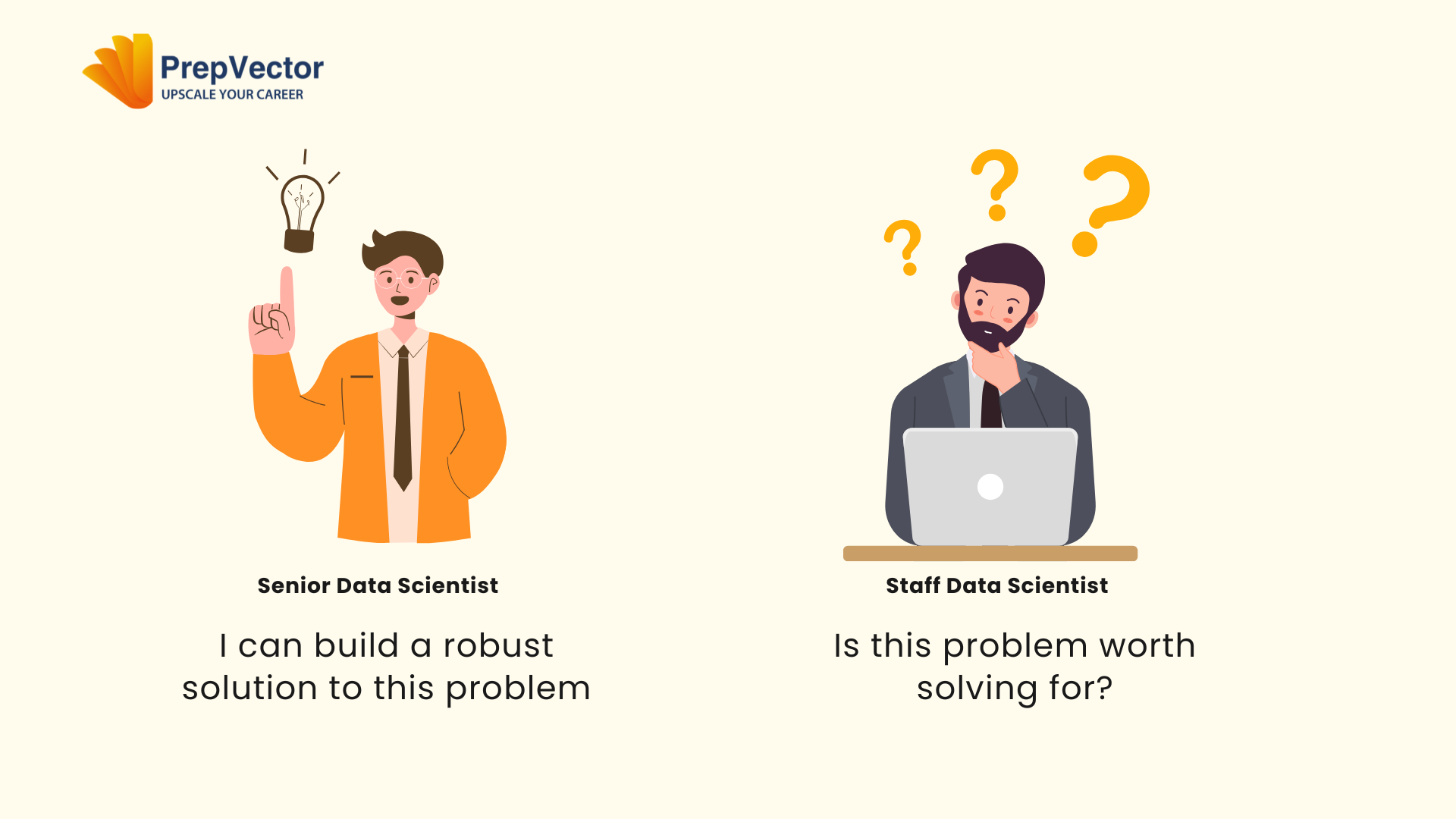
At the Senior level, success is often measured through strong technical delivery, domain expertise, and reliability. You’re rewarded for solving the problem in front of you and solving it well.
At Staff-level, a different layer of responsibility kicks in. The focus shifts from:
Solving scoped problems → defining the right problems
Delivering projects → driving organizational outcomes
Individual contribution → creating leverage across teams
Technical depth alone → technical judgment combined with influence
This transition is challenging because the role itself becomes less clearly defined. Ambiguity increases, stakeholder management becomes more important, and the ability to operate across functions becomes critical. But none of these show up cleanly in a sprint review.
Technical Depth Still Matters — But Differently
One common misconception is that Staff Data Scientists move away from technical work entirely. That’s not it.
Indeed, technical credibility becomes *more* important at higher levels. But how it is applied changes. At Senior level, you use technical skills to build things. At Staff level, you use it to:
Evaluate trade-offs
Guide technical direction
Unblock people
Improve decision-making
Create systems and processes that scale beyond you
The expectation evolves from simply executing well yourself to enabling an organization to execute effectively. That’s a meaningful difference — and one most Senior DSs aren’t explicitly prepared for.
Influence Without Formal Authority
Another major shift at the Staff level is the ability to influence outcomes without direct reporting structures.
Staff ICs are often expected to align engineering, product, analytics, and leadership teams around a common direction, without directly managing any of them. Communication, prioritization, and organizational awareness become essential parts of the role.
In many organizations, this becomes one of the defining differences between Senior and Staff-level impact. Senior DSs influence their immediate team. Staff DSs influence how the broader organization thinks and decides.
What Companies Are Increasingly Looking For
As organizations mature their AI and data capabilities, Staff-level expectations are becoming more structured around:
Strategic prioritization or knowing what is worth working on
Cross-functional leadership
Organizational influence
Long-term technical thinking
Ownership in ambiguous environments
Ability to scale systems, teams, and decision-making
In short, progression to Staff is rarely about “doing more work.” It is about increasing the scope and leverage of your impact.
Want to Go Deeper? Join Our Webinar
To explore these shifts in more detail, we’re hosting a live session:
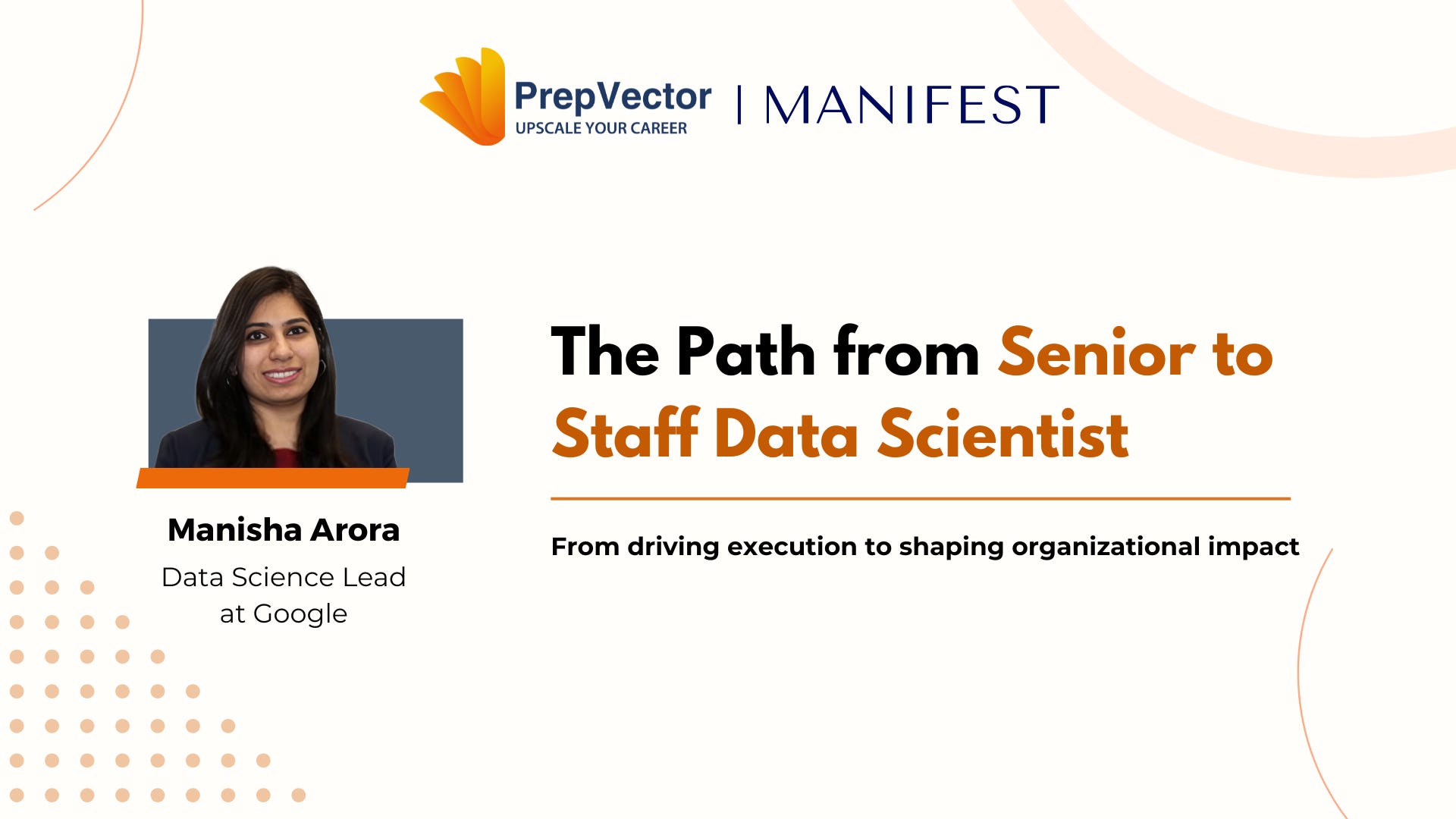
🌟 Webinar: The Path from Senior to Staff Data Scientist
🎙 Speaker: Manisha Arora, Data Science Lead at Google
📅 May 18, 2026
⏰8 PM EST / 5 PM PST
What We’ll Cover
Why the Senior → Staff transition is difficult
Technical scope vs organizational scope
The shift from execution to defining work
Building influence across teams
Becoming a force multiplier
Your questions, answered live
This session is intended for experienced Data Scientists, ML Engineers, and technical ICs looking for a more practical understanding of Staff-level expectations and growth.
Thank You Manifest Law for sponsoring this webinar. Manifest Law is an immigration-focused law firm that combines experienced attorneys with proprietary technology to simplify and modernize the immigration process for global professionals.
If you’d like to dive deeper into experimentation, here are a few of our learning programs you might enjoy:
A/B Testing Course for Data Scientists and Product Managers
Learn how top product data scientists frame hypotheses, pick the right metrics, and turn A/B test results into product decisions. This course combines product thinking, experimentation design, and storytelling—skills that set apart analysts who influence roadmaps.
Advanced A/B Testing for Data Scientists
Master the experimentation frameworks used by leading tech teams. Learn to design powerful tests, analyze results with statistical rigor, and translate insights into product growth. A hands-on program for data scientists ready to influence strategy through experimentation.
Master Product Sense and AB Testing and learn to use statistical methods to drive product growth. I focus on inculcating a problem-solving mindset, and application of data-driven strategies, including A/B Testing, ML, and Causal Inference, to drive product growth.
Not sure which course aligns with your goals? Send me a message on LinkedIn with your background and aspirations, and I’ll help you find the best fit for your journey.
Hello and thank you for this very interesting article. The rules of the game are changing, just as the required skills are changing as well. AI is shaping a new profile for this professional role, one centered around the ability to understand systems, identify and guide decisions, ensure workflows and outputs remain coherent, and at the same time manage ambiguity and gray areas.
At the same time, I feel both fascinated and intimidated by the period ahead of us. We will need to remain dynamic, curious, and fearless in order to navigate and embrace these transformations.