
How Experimentation Drives Product Growth
Learn how leading tech teams use experimentation to drive product growth, make smarter decisions, and unlock real business impact.

👋 Hey! This is Manisha Arora from PrepVector. Welcome to the Tech Growth Series, a newsletter that aims to bridge the gap between academic knowledge and practical aspects of data science. My goal is to simplify complicated data concepts, share my perspectives on the latest trends, and share my learnings from building and leading data teams.
I recently had the pleasure of speaking at Women In Tech about a topic I am passionate about: how product teams can drive growth using experiments.
A huge THANK YOU to Women in Tech team for organizing the conference and Daria Katun for facilitating the session.
Here’s a recap of the key ideas, along with real-world examples and frameworks you can apply to your work.
What Is Experimentation?
At its core, experimentation is about making informed bets.
It’s the process of trying out new ideas, features, or changes in a structured way—then using data to measure what works and what doesn’t. Unlike guesswork or gut decisions, experimentation allows you to test hypotheses, analyze real user behavior, and iterate with confidence.
In product teams, it’s not just about A/B tests—it’s about creating a culture where decisions are validated with evidence, not opinions.
When done well, experimentation helps you:
Uncover insights that lead to smarter product strategies
Prioritize features that deliver true value
Align teams with measurable goals
Build products that keep evolving with your users
It’s not just a technique. It’s a mindset that turns product development into a continuous learning cycle - one that can drive sustained growth at scale.
Why Experiments Matter in Product Growth?
Experiments aren't just about testing ideas. They’re about building a culture of evidence-based decision-making.
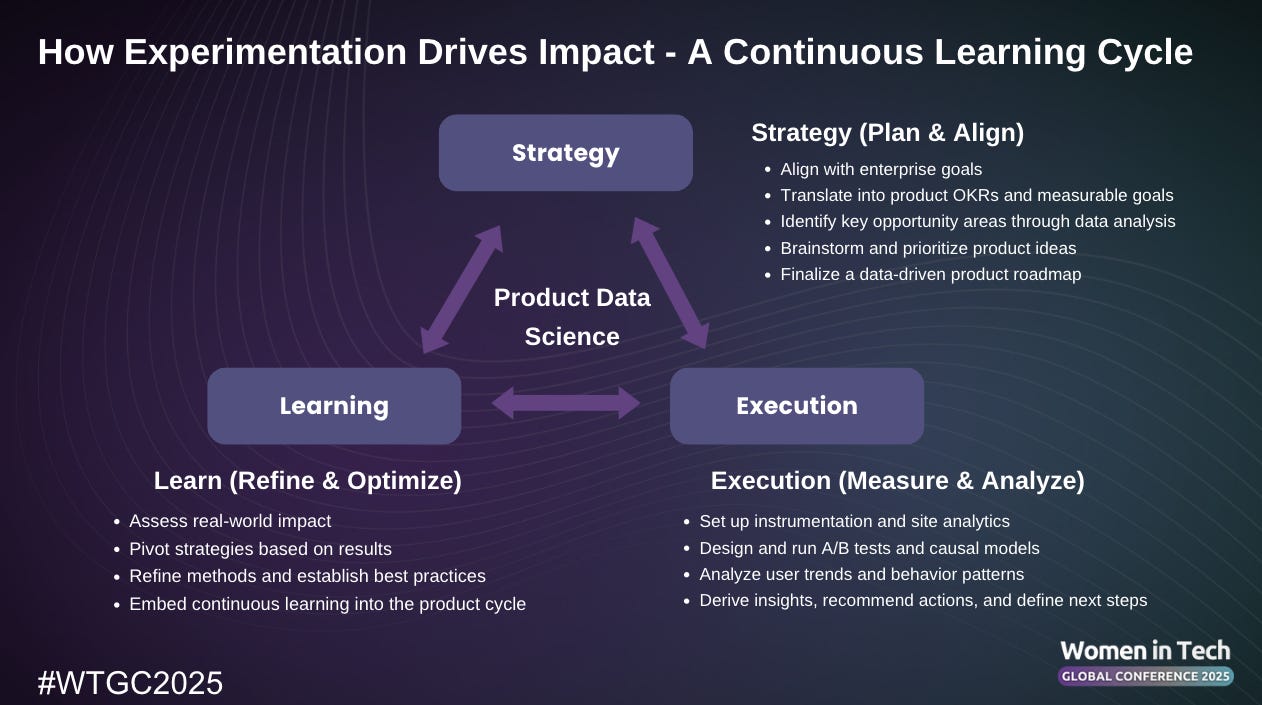
Whether you’re working on a new feature or refining a user journey, experimentation helps teams:
Strategy: Align efforts with larger business goals by turning strategy into measurable outcomes.
Execution: Uncover opportunities by analyzing real user data instead of relying on opinions or instincts.
Learning: Create a feedback loop where each test helps refine your product roadmap and execution.
It’s a cycle of continuous learning—plan, test, analyze, and optimize.
Kudos to Banani Mohapatra for building this amazing visual which depicts the strategy → execution → learning loop.
How to Design Experiments That Actually Work
Great experiments start with a great hypothesis.
That means you begin with a clear, data-informed assumption: “If we make this change, we expect this outcome.”
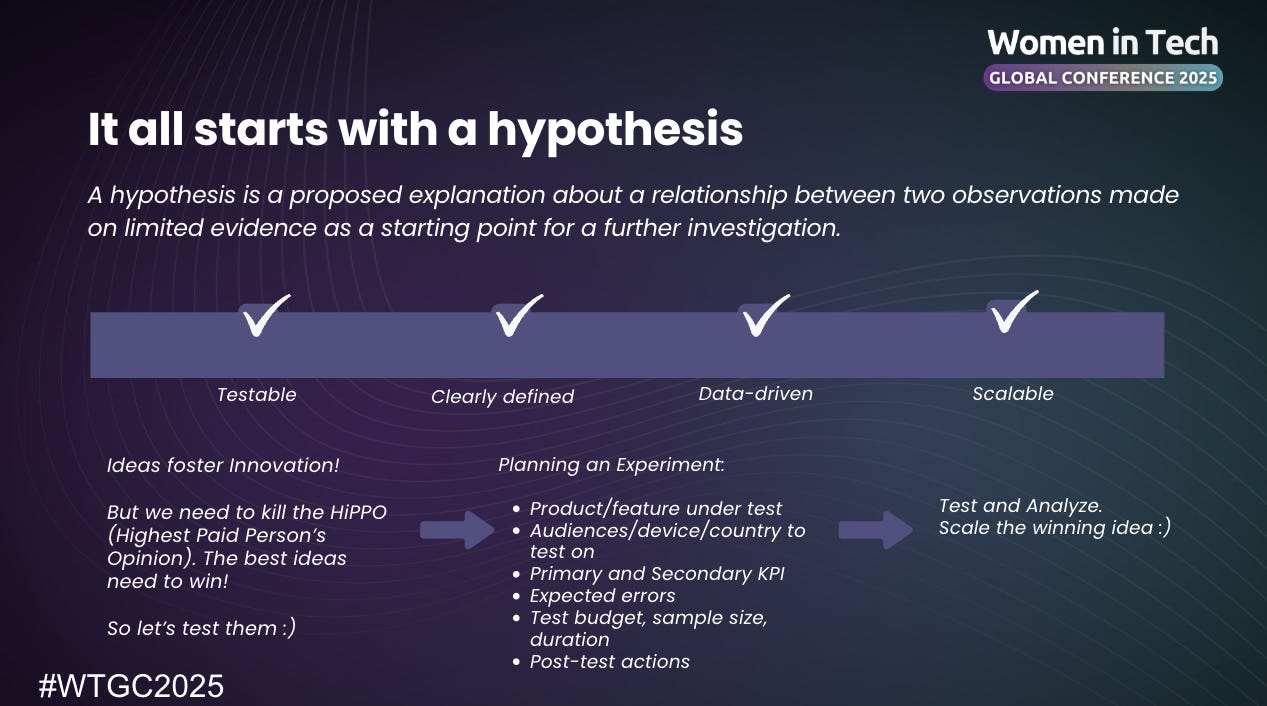
Here’s what else makes an experiment effective:
Be specific about what you’re testing—which feature, for which users, in which regions or devices.
Choose the right metrics. Don’t just track clicks or time spent—make sure they reflect true value to the user or business.
Think ahead. What’s your test duration? What sample size gives you reliable results? What will you do with the results?
The most impactful product teams treat experiments like scientific studies. That means using control groups, ensuring randomization, and designing with statistical rigor.
How to Read Results:
One of the biggest mistakes teams make is getting excited over a “statistically significant” result (e.g., p < 0.05) that doesn’t actually move the needle in practice.
Here’s the difference:
Statistical significance tells you the result probably didn’t happen by chance.
Practical significance tells you whether the result is meaningful enough to act on.
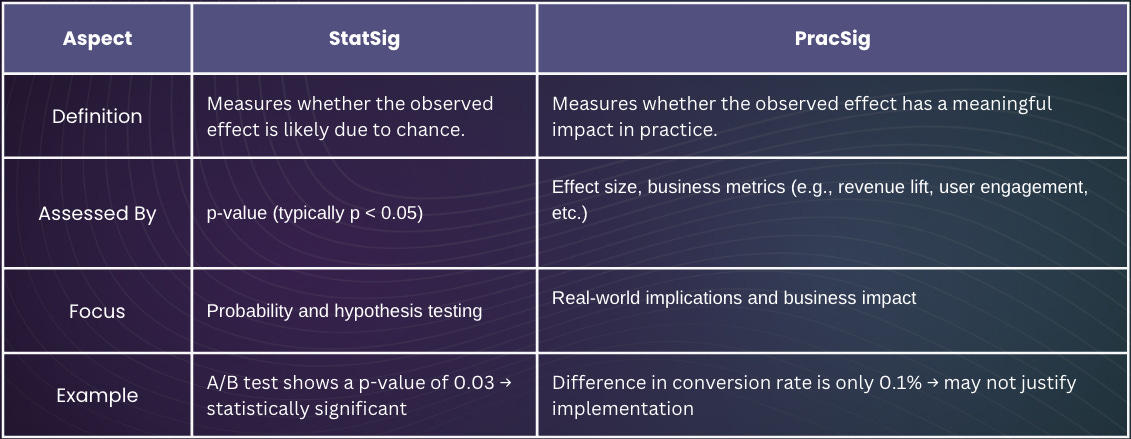
For instance, your test might increase signups by 0.1%—statistically significant, but maybe not worth the engineering effort to roll it out.
Always pair the numbers with business judgment.
👉 More detailed article on StatSig vs. PracSig here: Interpreting A/B Tests – StatSig vs. PracSig
Real Examples of Experiments That Moved the Needle
These stories show how powerful experimentation can be:
Airbnb improved their search experience by running structured tests alongside machine learning, leading to better user engagement.
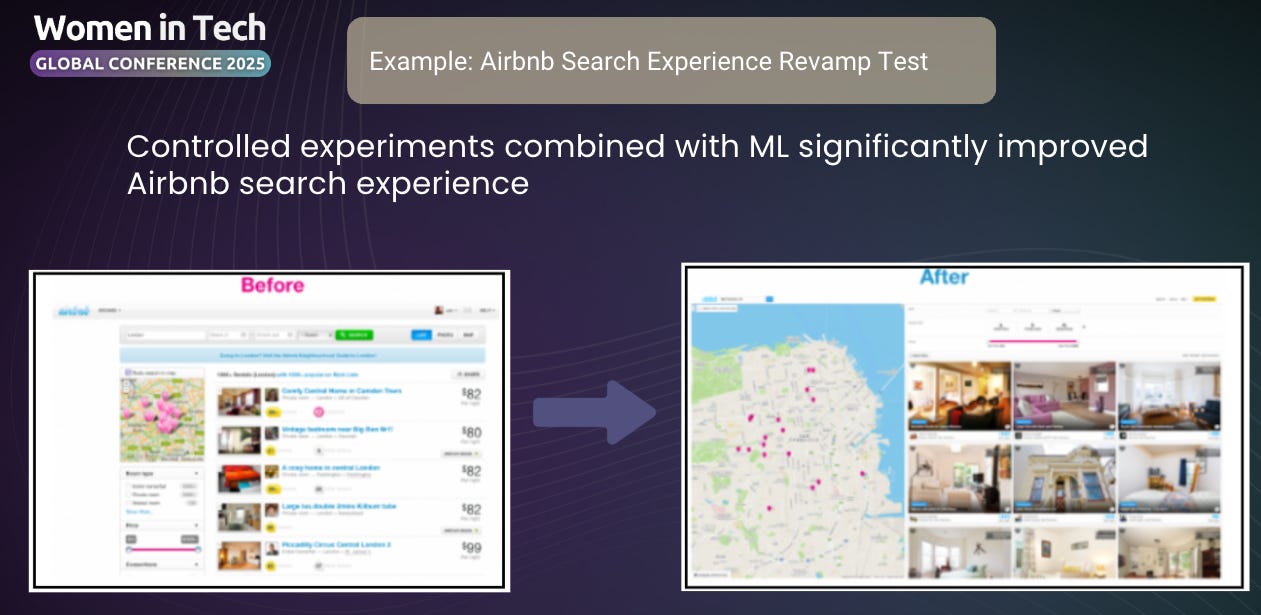
Source: https://www.geteppo.com/blog/machine-learning-teams-are-ab-experimentation-teams
Bing changed their color scheme—and after validating it through testing, the update generated over $10 million in revenue.


Source: https://ai.plainenglish.io/you-are-a-subject-in-hundreds-of-experiments-a-day-9fe65a2982ff
Amazon moved credit card offers from their homepage to the shopping cart page. That simple change? It added tens of millions in profit.
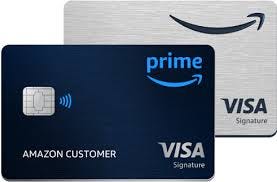
When done right, even small changes can lead to massive impact, especially on high-traffic platforms.
Happy Testing!
Upcoming Courses:
Master Product Sense and AB Testing, and learn to use statistical methods to drive product growth. I focus on inculcating a problem-solving mindset, and application of data-driven strategies, including A/B Testing, ML, and Causal Inference, to drive product growth.
AI/ML Projects for Data Professionals
Gain hands-on experience and build a portfolio of industry AI/ML projects. Scope ML Projects, get stakeholder buy-in, and execute the workflow from data exploration to model deployment. You will learn to use coding best practices to solve end-to-end AI/ML Projects to showcase to the employer or clients.
Not sure which course aligns with your goals? Send me a message on LinkedIn with your background and aspirations, and I'll help you find the best fit for your journey.